


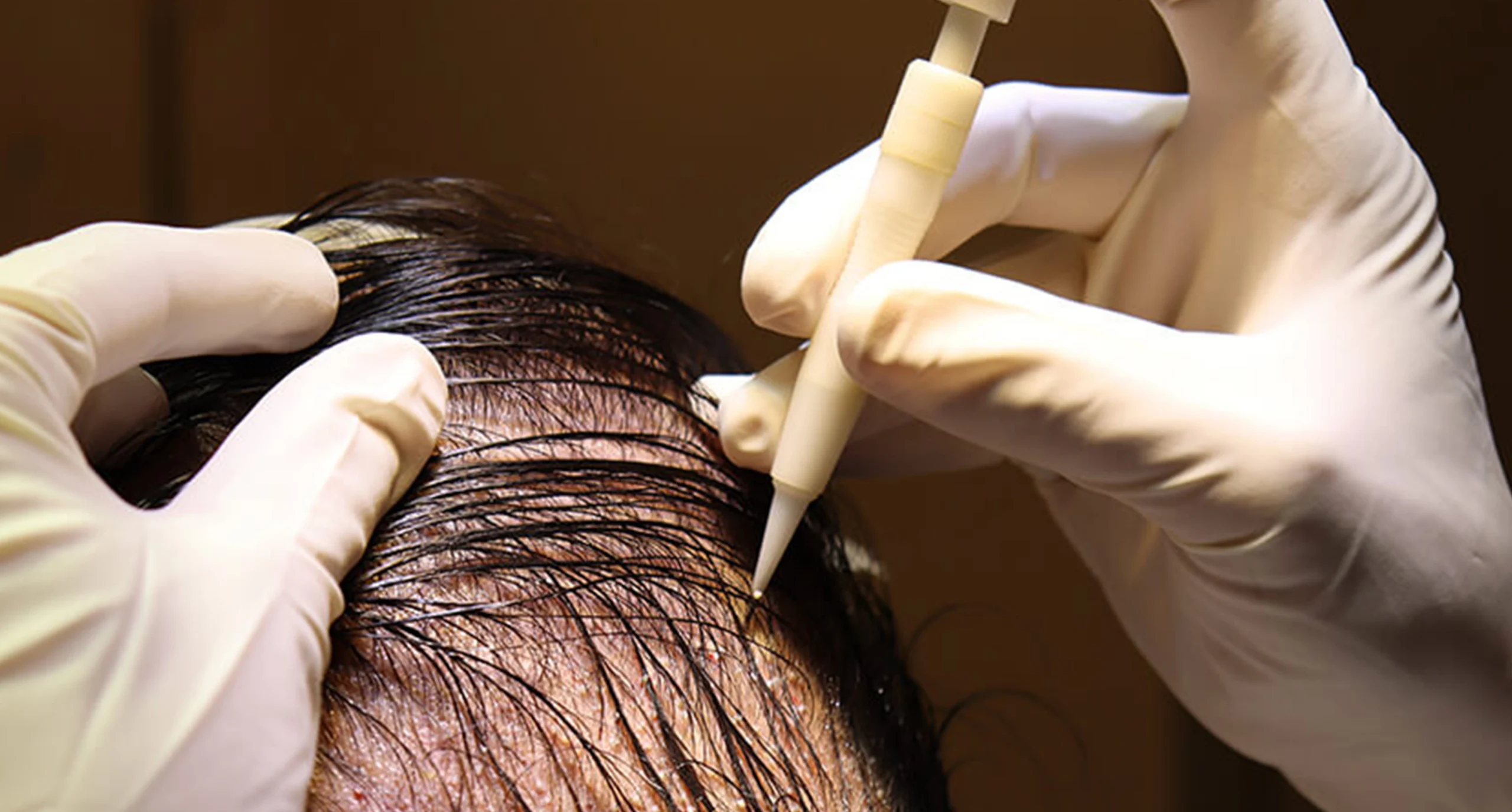
DHI (Direct Hair Implantation) hair transplant is one of the most advanced techniques in modern hair restoration. It combines the FUE harvesting principle with a specialised implanter pen — the Choi pen — that opens the channel and places the graft in a single, controlled motion. The result: ultra-precise density, natural-looking angles and a faster recovery for many patients. In this guide you will find what DHI is, how it differs from Sapphire FUE, who it is best suited for, every step of the procedure, recovery milestones, after-care tips and the most frequently asked questions.
What is DHI Hair Transplant?
DHI is a refined version of the FUE method. The harvesting of follicles from the donor area is identical: hair grafts are extracted one by one with a micromotor. The key difference is the implantation stage. Instead of opening channels first and inserting grafts afterwards, the surgeon loads each graft into a Choi pen and implants it directly into the recipient area in one step.
Because channel opening and implantation happen simultaneously, grafts spend less time outside the body, which can support a higher survival rate. The Choi pen also allows surgeons to control the depth, angle and direction of each implant with extreme accuracy — ideal for designing a natural front hairline and reaching very high density in the crown.
DHI does not require shaving the recipient area in many cases, making it a popular option for patients who want a discreet procedure or do not wish to change their daily appearance dramatically.
DHI vs. Sapphire FUE
Both techniques deliver excellent results in experienced hands. The right choice depends on your goals, donor capacity, the area to be treated and your daily routine.
| Feature | DHI | Sapphire FUE |
|---|---|---|
| Channel opening | With the Choi pen, simultaneously with implantation | With a sapphire-tipped pen, before implantation |
| Density | Very high — ideal for crown & hairline | Very high — ideal for wide areas |
| Recipient area shaving | Often not required | Usually required |
| Procedure time | Longer (technique is more delicate) | Standard |
| Recovery | Fast — minimal trauma | Fast — minimal trauma |
| Best for | Smaller, high-density areas, unshaven cases | Wide coverage, larger sessions |
Both methods are sutureless and scar-free. Your hair restoration specialist will recommend the option that best matches your goals and physiology.
How is DHI Performed?
A DHI procedure typically lasts 6-8 hours under local anaesthesia. The patient is awake throughout but feels no pain. The operation moves through five clear stages:
- Consultation & planning: Donor capacity, hair loss pattern (Norwood/Ludwig) and desired hairline are mapped. Estimated graft count and coverage area are confirmed.
- Local anaesthesia: The donor and recipient zones are numbed with a comfort-first protocol.
- Graft harvesting: Follicular units are extracted one by one from the donor area (typically the nape) using a micromotor. Grafts are kept in a cold preservation solution.
- Direct implantation with the Choi pen: Grafts are loaded into specialised Choi pens. The surgeon opens the channel and places the graft in a single motion, controlling depth, angle and direction precisely.
- Final check & after-care brief: The recipient area is reviewed for density, angle consistency and natural transition. Personalised after-care instructions are provided.
Before Your Procedure
- Stop blood thinners (aspirin, ibuprofen, etc.) one week prior — only with your doctor’s approval.
- Avoid alcohol for at least 48 hours before the operation.
- Reduce or stop smoking — nicotine slows wound healing.
- Do not apply gel, wax or spray on the day of the procedure.
- Eat a light meal before arriving and stay well hydrated.
Who is DHI Suitable For?
DHI is well-suited to patients who want extremely high density in a defined area or wish to keep their existing hair length (no shaving). It is performed for both men and women.
- Patients seeking a denser front hairline or crown coverage
- Women with diffuse thinning who cannot shave their hair
- Patients who have had a previous transplant and want density refinement
- Younger candidates with limited, well-defined balding areas
- Patients with strict daily routines who need a discreet procedure
- People targeting a precise, designer hairline
Who is DHI Not Suitable For?
- Patients with insufficient donor capacity for the desired result
- Cases of very large coverage where a longer single session is not advisable
- People with active, unstable hair loss (stabilise first)
- Patients with uncontrolled chronic conditions that may slow healing
- Anyone with unrealistic expectations of a one-day full transformation
Advantages of DHI
- Single-step channel opening and implantation — minimal graft handling
- Very high density in the recipient area
- Often performed without shaving the recipient zone
- Precise control of angle, depth and direction
- Excellent for hairline and crown restoration
- Minimal post-operative crusting
- Sutureless, scar-free
- Comfortable, well-tolerated procedure
Recovery Timeline
Recovery after DHI is generally smooth thanks to the minimal channel size. The general schedule is:
- Days 1-3: Mild swelling, sleep with the head elevated, follow medication and ice protocol.
- Day 3-5: First professional wash, gentle care, light daily activity is fine.
- Day 10-15: Crusts fall away completely; visible redness reduces.
- Month 1-3: Possible shock loss — temporary and expected.
- Month 4-6: New hair emerges and starts to lengthen.
- Month 12-18: Final density and full styling possible.
Things to Do
- Follow the prescribed washing protocol step by step
- Sleep with your head elevated for the first 3 nights
- Drink plenty of water and stick to a protein-rich diet
- Attend every scheduled follow-up
Things to Avoid
- Touching or scratching the recipient area
- Heavy sports, sauna, hammam and swimming for the first month
- Direct sunlight on the scalp
- Tight hats or helmets
- Smoking and alcohol during recovery
DHI Pricing
DHI is typically a longer, more delicate procedure than Sapphire FUE, which is reflected in pricing. Final cost depends on the graft count, the area to be treated, and whether complementary therapies (PRP, mesotherapy) are added. At Hair Noard pricing is transparent — you receive a clear breakdown after your free consultation, with no hidden fees.
DHI Combined With Other Treatments
To maximise graft survival and hair quality, DHI is often combined with supportive therapies:
- PRP therapy — concentrated platelets stimulate follicles and accelerate healing.
- Hair mesotherapy — micronutrient injections strengthen existing hair.
- Stem cell support — regenerative protocols for advanced cases.
Why Choose Hair Noard for DHI?
Hair Noard performs DHI in fully accredited facilities using the latest generation of Choi implanter pens. Every plan is personalised — we never apply a one-size-fits-all protocol. From your free consultation through your long-term follow-up, our team is here to make your hair restoration journey safe, comfortable and successful.
Frequently Asked Questions
Does DHI hurt?
No. Local anaesthesia ensures the procedure is pain-free. You may feel mild pressure or vibration, but no actual pain. Mild tenderness is normal during the first 24-48 hours after surgery.
Will I need to shave my head?
In many DHI cases the recipient area does not need to be shaved. The donor area may need a small section shaved to harvest grafts, but this is usually concealed by surrounding hair.
How many grafts can be transplanted in one session?
Depending on donor capacity, DHI typically allows 2,500-4,500 grafts in a single session. Very large coverage may be planned over multiple sessions.
How long until results are visible?
Most new hair starts to emerge between months 4-6. Final density is reached around months 12-18.
Will the transplanted hair fall out?
Grafts harvested from the donor zone are genetically resistant to shedding, so transplanted hair is permanent. Early shock loss is temporary — new hair regrows from the same follicle.
What is the difference between DHI and Sapphire FUE?
DHI uses a Choi implanter pen that opens the channel and places the graft in a single step. Sapphire FUE uses sapphire-tipped blades to create channels in advance, and grafts are implanted afterwards. Both deliver natural, dense results — your specialist will recommend the right method for you.
To find out whether DHI is the best fit for you, get in touch with us for a free, no-obligation consultation.